
Why Fractional Makes Sense
Interim and fractional C-suite leadership isn’t just a buzzword or the latest trend - it’s reshaping the executive landscape as we know it.
As companies seek greater agility and efficiency, fractional advisory and executive roles are gaining momentum across the venture capital and private equity ecosystems, providing access to tenured leadership without the commitment of a full-time hire.
Fractional advisors and executives are seasoned professionals who join a company on an interim basis (typically 1–3 days per week) as embedded leaders, take ownership of outcomes, manage teams and drive strategy at a fraction of the cost of a full-time executive.
TLDR
Fractional executives often include roles like CFOs, CTOs, CPOs or COOs, offering strategic guidance on a part-time / retained basis
They provide expertise that is cost effective and flexible
Startups can engage strategic experts at a fraction which in return can reduce hiring budgets by up to 50%
Their adaptability enables startups to respond to evolving market needs and navigate strategic shifts efficiently
They have a meaningful impact on growth, innovation and introductions to valuable partners within their established networks
VC and PE firms are increasingly endorsing this solution to their portcos as a cost-effective solution to manage runway, scale operations and exposure to top tier talent
This engagement style represents a pivotal mindset shift in the redesign of startup leadership, founder support and people management.
Flexibility & agility
This model allows companies the ability to scale leadership needs up or down in response to changing market dynamics. It provides the leverage of utilising seasoned professionals, without the commitment to hire full-time, making it particularly valuable for startups and growing businesses.
At the same time, executives themselves are embracing portfolio-style careers, with many opting for fractional or interim engagements over traditional full-time commitments. This shift is fuelling the growth of an executive ‘gig economy’ and challenging conventional employment norms.
Access to elite talent
The rise of fractional hiring reflects broader changes in how organisations tap into valuable expertise. With companies now facing the challenges of tighter budgets, rising operating costs, rapid AI adoption, workforce restructuring and remote and hybrid work environments, this model offers an alternative approach to securing talent.
Fractional executives often provide learned knowledge and intrinsic insight that may otherwise be out of reach. Drawing on experience across multiple organisations and industries, they bring fresh perspectives, challenge conventional thinking, avoid internal politics and legacy assumptions and introduce proven practices that have delivered results in other environments.
Accelerated growth
Companies that leverage fractional leaders often demonstrate faster execution and improved growth outcomes, with some reporting growth rates of up to 30%. With years and often decades of demonstrated experience, these individuals arrive with proven frameworks, established playbooks and a clear understanding of what exceptional looks like. They can quickly identify opportunities, address challenges and create impact from day one - eliminating the acclimation time lag associated with traditional hiring and onboarding.
Coaching & business strategy
Fractional executives do more than solve immediate business problems. They establish sustainable systems, processes, operating rhythms and performance metrics that continue to create value long after their engagement ends.
Many also play an active coaching and mentoring role, developing internal talent and equipping emerging leaders with the skills and confidence to eventually take ownership of the function.
The result?
A market that's increasingly valuing flexible, high-impact strategic leadership that can be engaged on demand, rather than tied to long-term employment contracts.
This signals a critical reset from the traditional models, prompting companies to pivot, rethink and redefine how they shape and build leadership strategy in this new and evolving space.
As businesses continue to evolve, fractional leadership is steadily becoming an important part of the modern management toolkit.
Key differences at a glance
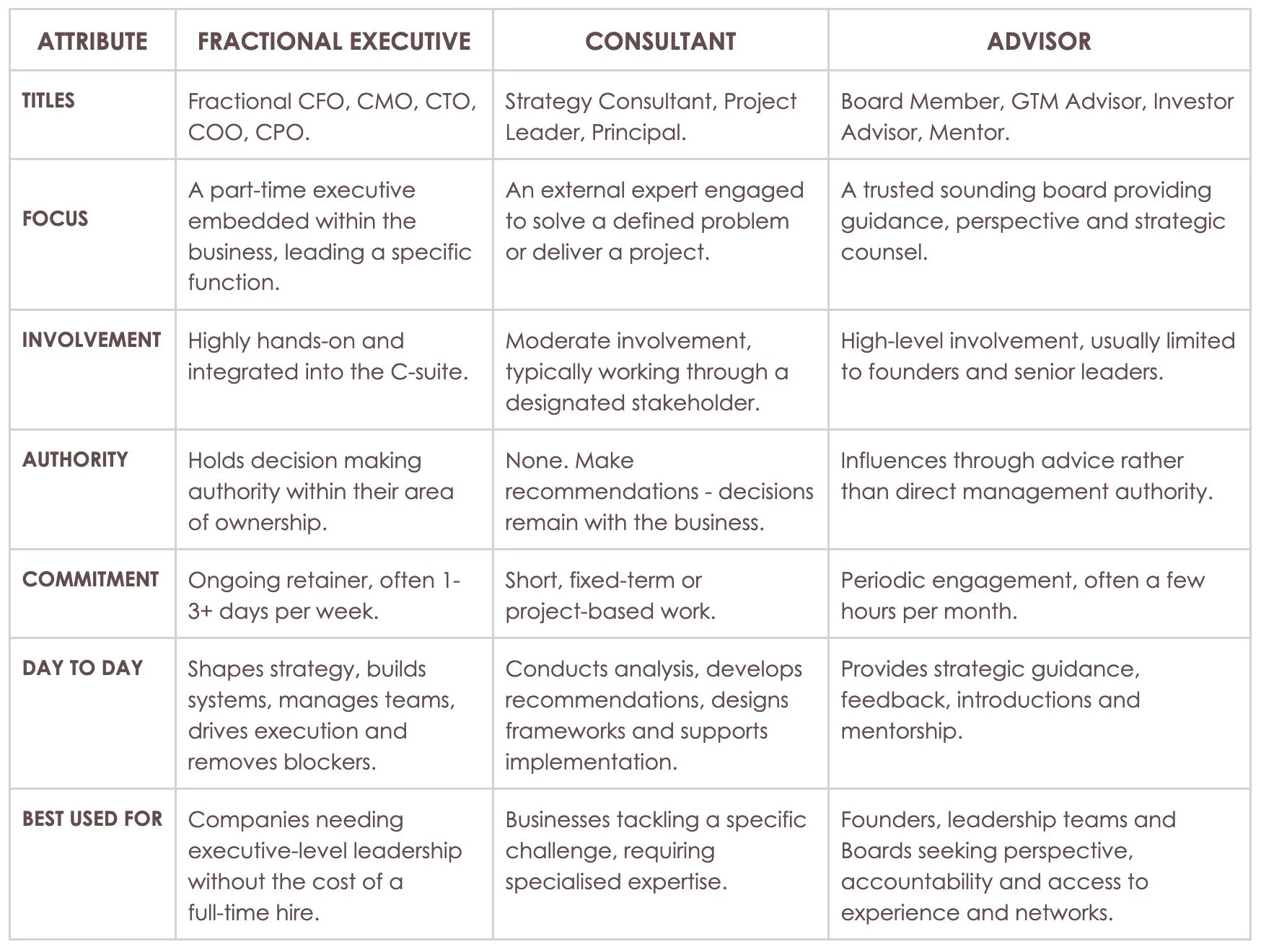
Role Comparison Chart